Kearny Street Police Station
The Kearny Street Police Station stands as the grim administrative heart of the Pacific States of America's law enforcement, a place where the novel's themes of racial persecution, arbitrary justice, and moral crisis converge. It is here that Frank Frink, a Jewish man living under Japanese rule, is brought after his arrest for fraud, and it is here that his fate—whether he will be handed over to the German Reich for extermination—is decided. The station is not merely a setting but a symbol of the precariousness of life in a world where the law serves the powerful, and where a single signature can mean the difference between freedom and death.
Frank Frink's Arrest and Detention
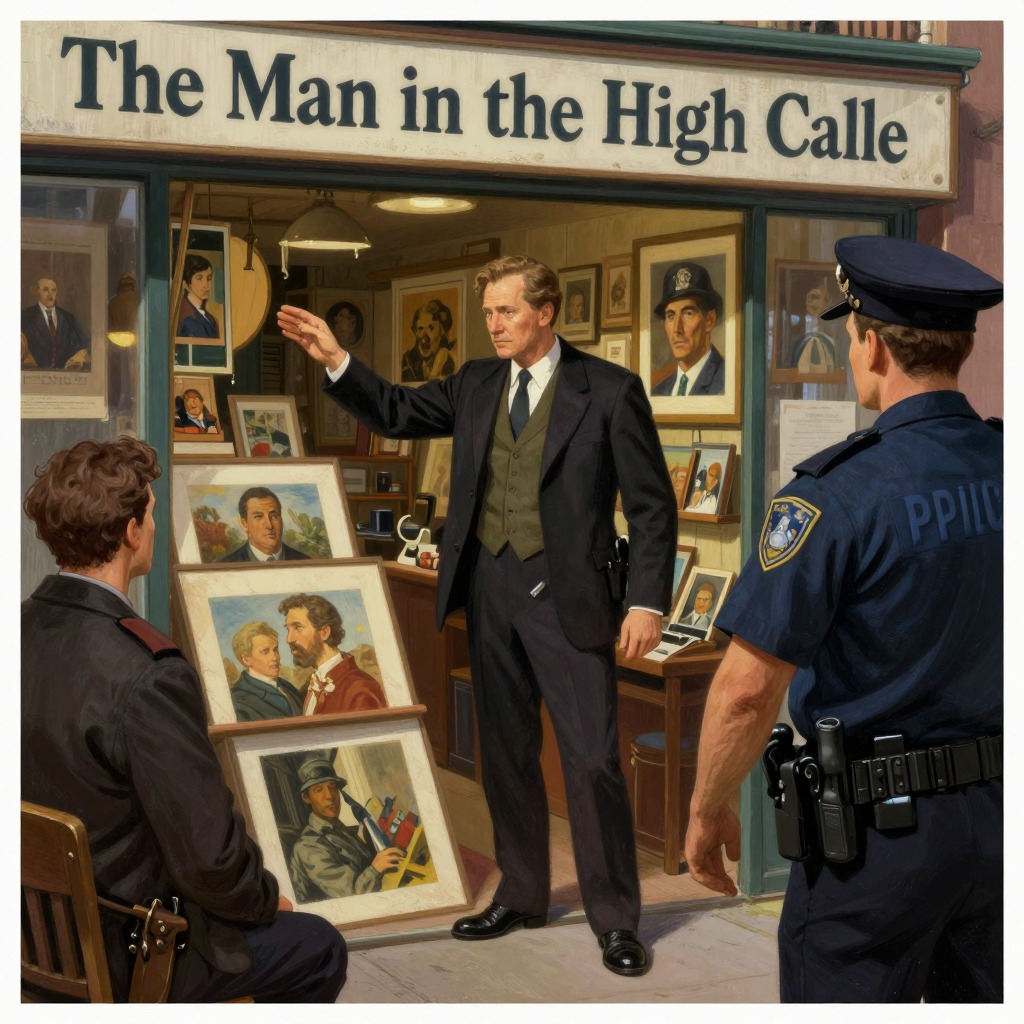
Frank Frink is arrested on the sidewalk outside his basement workshop, where he has been smoking a T'ien-lai marijuana cigarette, by plainclothes officers who inform him he is wanted for "Bunco"—the fraud charge stemming from Robert Childan's accusation that Frink, posing as an admiral's gentleman, tried to sell him a fake Colt .44 revolver. The officers hustle him into an unmarked Toyopet and drive him to the Kearny Street Station, where he is booked. During the booking process, one of the cops asks, "Is your real name Fink?" and then, with a folder in hand, declares, "You're a kike. Refugee from Europe." Frink protests that he was born in New York, but the cop insists, "You're an escapee from the Nazis. You know what that means?" The implication is clear: Frink is to be held for the German consul, who wants to try him under German law. When Frink breaks away and runs across the garage, he is stopped by armed police, handcuffed, and led back. The station becomes the place where his carefully constructed identity as an American is stripped away, revealing the Jewish heritage that makes him a target for the Reich's racial laws.
The German Consul's Demand and Tagomi's Intervention
Later that day, the German consul, Freiherr Hugo Reiss, arrives at the Kearny Street Station, having been summoned by the San Francisco Police Department to deal with the aftermath of the SD raid on the Nippon Times Building. Reiss has spent hours at the station and the morgue, reading the accounts of the shooting. He meets Nobusuke Tagomi in the corridor of the Nippon Times Building, not at the station, but the station is where the legal machinery of the Reich's demand is processed. Reiss presents Form 20-50, a request for the remand of "Jew named Frank Fink, citizen—according to Reichs law—of Germany, retroactive June, 1960," for protective custody under Reichs law. Tagomi, still reeling from the violence he has committed, takes the form and, instead of signing it, scribbles "Release. Ranking Trade Mission, S.F. authority. Vide Military Protocol 1947. Tagomi" on the bottom. He hands the carbon to Reiss, effectively nullifying the extradition request. This act, performed in the shadow of the station's authority, is a direct challenge to the Reich's power and a moral stand against the persecution of Frink.
Frank Frink's Release and Return to the Workshop
That evening, a police officer comes to Frink's cell, unlocks the door, and tells him to collect his possessions at the desk. Frink finds himself on the sidewalk before the Kearny Street Station, among the passers-by, with no explanation for his release. He reflects that he was "Arrested for no real reason" and then let go the same way, a "Miracle" and a "Fluke." He wanders through the darkening city, thinking of his new life, and returns to the basement workshop where Ed McCarthy is eating dinner. Frink crouches by the electric heater, then collects half-finished silver segments and begins buffing them at the arbor, resuming his work as if nothing had happened. The station, which had threatened to send him to Germany and extermination, recedes into the past, but the memory of the terror—the handcuffs cutting into his flesh, the cops' taunts—remains a defining trauma.
The Station as a Nexus of Power and Moral Choice
The Kearny Street Police Station is more than a physical location; it is a nexus where the novel's power structures intersect. It is where the San Francisco Police Department, a pinoc institution, enforces the will of the Japanese occupation and, by extension, the Reich's racial policies. It is where the German consul can demand a man's life with a piece of paper, and where a Japanese official can countermand that demand with a scribbled note. The station embodies the arbitrary nature of justice in a totalitarian world, where Frink's fate depends not on his innocence but on the intervention of a man he has never met. Tagomi's decision to release Frink, made in the aftermath of his own violent act, is a moment of moral clarity in a novel otherwise mired in ambiguity. The station, then, becomes the stage for a small but significant act of resistance, a reminder that even in the darkest of times, individual choices can alter the course of lives.